


 Date:2025.09.03
 Views: Loading


Stakeholders now navigate the trade-offs between three leading technologies: the mature and bankable Lithium Iron Phosphate (LFP), the low-cost potential of Sodium-Ion (Na-ion), and the ultra-durable Vanadium Redox Flow (VRF) battery. The optimal choice is entirely dependent on the specific application, creating a complex but opportunity-rich landscape.
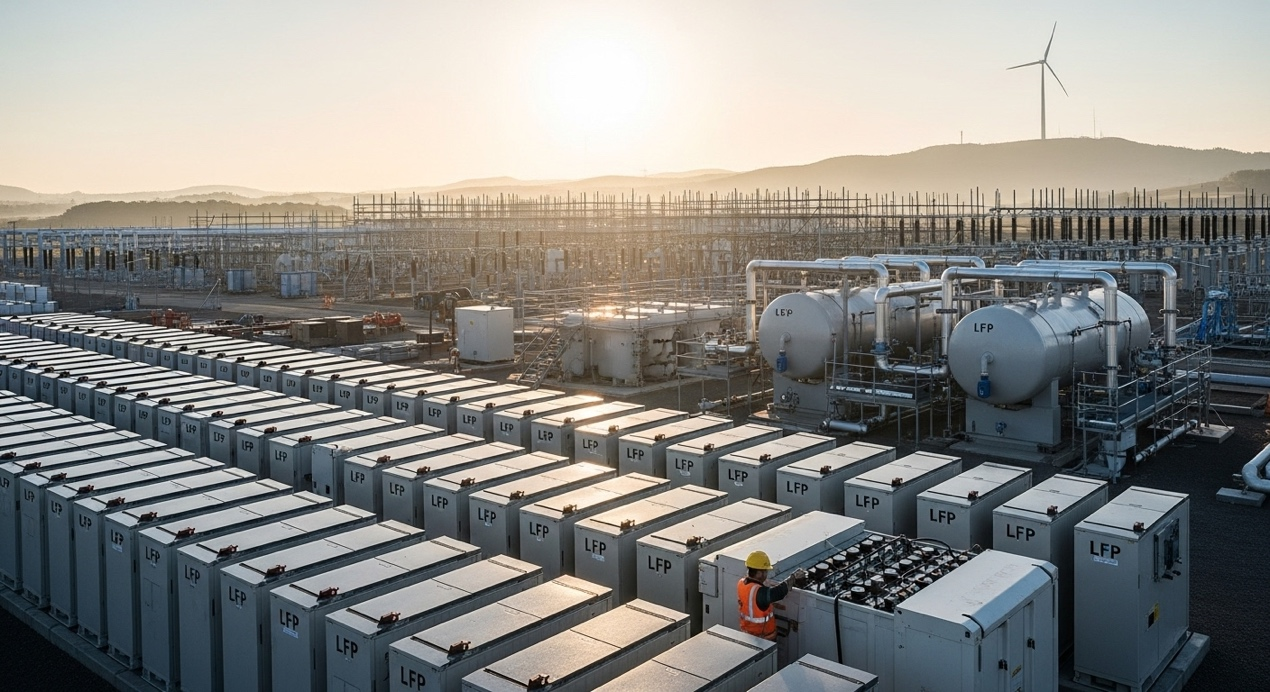
LFP (Lithium Iron Phosphate) - The Bankable Workhorse
Lithium Iron Phosphate (LFP) technology is the entrenched incumbent in the grid battery storage market, representing the benchmark against which all challengers are measured.Its dominance is built on a foundation of proven bankability. As a fully mature (TRL 9) technology with a decade-plus track record, LFP gives financial institutions the confidence to provide low-cost project financing. This "bankability moat" is a powerful competitive advantage. Its strengths also include a robust global supply chain, high round-trip efficiency of 85-95%, and excellent safety compared to other lithium-ion chemistries. This combination makes LFP the undisputed economic leader for short-duration applications of 2-4 hours.
However, LFP technology has a key architectural limitation that challenges its use in LDES. Its power and energy costs are inherently coupled, meaning that to double the storage duration, you must double the number of expensive battery packs. This makes it economically difficult to scale for applications requiring 8 or more hours of storage, opening the door for alternative chemistries specifically designed for longevity.
The Challengers: A Tale of Two Chemistries
Two primary challengers, Sodium-Ion and Vanadium Flow, are emerging to address the limitations of LFP, particularly in the growing long duration energy storage market.1. Sodium-Ion (Na-ion): The Low-Cost Disruptor
Na-ion is a disruptive challenger whose primary advantage lies in its raw materials. Sodium is thousands of times more abundant than lithium and can be sourced cheaply and ethically, promising a significantly lower long-term cost. While its energy density is currently lower than LFP's, it is sufficient for stationary storage and has key operational advantages, including superior safety and excellent performance in extreme cold, which can reduce overall system costs.Crucially, Na-ion can be a "drop-in" technology for existing lithium-ion manufacturing lines, which dramatically accelerates its path to achieving economies of scale. Its main hurdles are building a track record to achieve full bankability and scaling its nascent supply chain.
2. Vanadium Redox Flow (VRF): The Long-Duration Champion
Vanadium Flow batteries are the specialized champions of high-throughput, long-duration grid storage. Their unique architecture decouples power (the reactor stack) from energy (the electrolyte tanks), allowing for cost-effective scaling of storage duration. Want more energy? Just add bigger tanks and more liquid electrolyte.VRF's defining feature is its extraordinary cycle life of over 20,000 cycles with virtually no degradation of the vanadium electrolyte, positioning it as a 20+ year infrastructure asset. It is also inherently safe, using a non-flammable water-based electrolyte. These advantages are offset by a high upfront capital cost, driven by the price of vanadium, and a much larger physical footprint due to its lower energy density.

Head-to-Head: The Ultimate Comparison Matrix
Choosing the right grid battery storage technology requires a direct comparison of their performance, economic, and commercial attributes. The optimal solution depends on the project's specific requirements for duration, cycling, and lifetime cost.| Metric | Lithium Iron Phosphate (LFP) | Sodium-Ion (Na-ion) | Vanadium Redox Flow (VRF) |
| Upfront CAPEX (4-hr) | Lowest | Approaching LFP levels | Highest |
| Projected 2030 LCOS (10-hr) | ~$0.070/kWh | ~$0.255/kWh (High uncertainty) | ~$0.055/kWh |
| Cycle Life | 2,500–9,000+ | 3,000–6,500+ | 15,000–20,000+ |
| Footprint / Energy Density | Highest Density (Most Compact) | Medium Density | Lowest Density (Largest Footprint) |
| Round-Trip Efficiency | 85–95% | 90–95% | 70–85% |
| Safety (Thermal Runaway) | Low | Very Low | Negligible |
| Technology Maturity / Bankability | TRL 9 (Fully Bankable) | TRL 6-8 (Emerging) | TRL 7-8 (Bankable w/ guarantees) |
For 4-Hour Scenarios, LFP is the clear winner. Its market-leading low CAPEX, high efficiency, and proven bankability make it the default choice for the majority of today's grid storage projects. For 8-Hour+ Scenarios, the decision is more complex.
VRF becomes highly competitive due to its extreme longevity and cost-effective duration scaling, which can result in a lower lifetime cost (LCOS) for projects that cycle daily. Na-ion is the high-potential challenger, aiming to beat LFP on upfront cost while offering safety and temperature advantages.
Great Power: A Leader in LFP and Na-ion Battery Technology
As a BNEF Tier 1 listed energy storage manufacturer, Great Power has over two decades of experience and proven bankability in the LFP market. Their prismatic LFP cells are designed for large-scale grid storage systems and offer excellent performance, with some models specified for a cycle life of at least 4,000 cycles. This makes them a reliable choice for developers building LFP projects today.Recognizing the future of grid energy storage, Great Power has also made a strategic move into Na-ion technology. The company is already deploying commercial-scale Na-ion projects, including a 5MW/10MWh system in China. Their Na-ion roadmap targets impressive performance, including a polyanion system with a target cycle life of over 6,000 cycles, showcasing their commitment to bringing this next-generation, low-cost technology to the mass market.
Conclusion
The evolution of the grid storage market shows there is no single "best" battery technology. Instead, the future will be a synergistic ecosystem where different chemistries are deployed for their specific strengths.For investors and project developers, success no longer comes from picking a single winner. It requires a dynamic and nuanced approach, moving beyond simple upfront cost comparisons to a sophisticated analysis of lifetime cost, application, and duration. Choosing the right technology for the right job is the key to building the resilient and decarbonized energy infrastructure of tomorrow.
 Consulting & Services
 Great Power